
Psychological first aid kits are the real-world implementation of psychological first aid (PFA), designed as a Second Aid kit to fit alongside existing First Aid kit infrastructure.
First Aid kits stabilise the body. Second Aid kits stabilise the mind.
This solves a critical gap: while PFA is widely recognised, it has not been operationalised for immediate, universal use in real-world environments, nor designed to fit public health infrastructure.
Second Aid enables that.
Kit topics:
- What is Second Aid?
- How it works
- Why it works
- Deployment
- Psychological First Aid Kit vs Training
- Limitations
What is Second Aid?
Second Aid is the public deployment format of psychological first aid.
While psychological first aid training is widely recognised, it is not readily available in real-world situations at the point of need:
- The general public is not trained in psychological first aid
- Distress occurs outside structured or supported environments
- Many individuals do not actively seek support
As existing First Aid kits do for physical first aid, Second Aid provides a clear deployment layer for psychological first aid, making support:
- Immediate
- Visible
- Self-administered
It functions as the mental health equivalent of a First Aid kit, focused on early stabilisation.
How it works
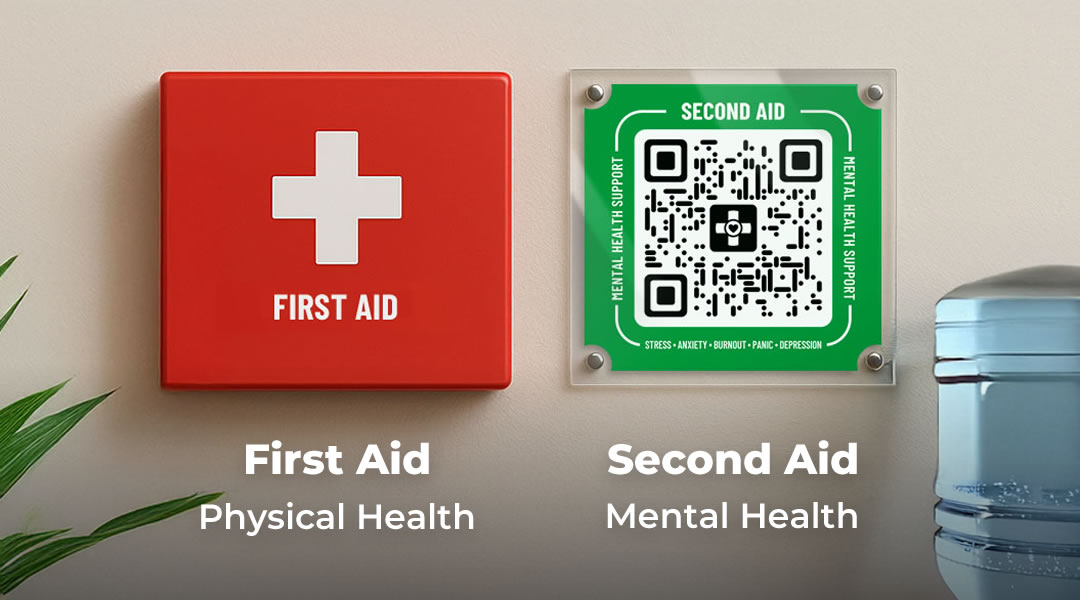
Second Aid QR codes are placed alongside First Aid kits or in clearly visible locations, providing direct access to structured, evidence-based psychological exercises designed to:
- Reduce immediate distress
- Regulate their state
- Restore a sense of control
The exercises are based on established psychological methods, including CBT, mindfulness, and behavioural techniques, adapted into simple, self-guided steps for immediate, real-world use.
- Paced diaphragmatic breathing for parasympathetic activation
- Affect labelling and cognitive defusion
- Behavioural activation and cognitive load regulation
At all times, the system provides access to professional support helplines if needed.
Why it works
Second Aid is designed not only on evidence-based psychological methods, but also across multiple scientific domains to enable PFA to scale beyond training environments.
Epidemiology: Scalable Self-Administration
Traditional psychological first aid relies on trained delivery, limiting reach.
Second Aid removes this constraint by enabling self-administration, allowing support to scale across populations without proportional increases in trained personnel.
Social Science: Stigma Bypass and Behavioural Adoption
A significant barrier to mental health support is non-engagement.
By enabling private, anonymous use with no admission or identity, Second Aid applies social science principles to reduce stigma and increase real-world usage.
Behavioural Psychology: Environmental Triggering
Access alone does not ensure usage.
Placement alongside First Aid kits introduces environmental cues, increasing the likelihood of engagement at the exact moment distress occurs.
This applies behavioural psychology to bridge the gap between availability and action.
Deployment
Second Aid is designed for universal placement, not limited to disaster or emergency scenarios, and can be deployed across a wide range of environments:
- Workplaces
- Schools and universities
- Hospitals and healthcare settings
- Public spaces
- Transport hubs
- Events and venues
- Residential environments
Deployment should focus on visibility and accessibility.
- Place QR-based kits in clearly visible locations
- Position alongside existing First Aid kits where possible
- Ensure immediate access without instructions or barriers
Placements should enable awareness and accessibility at the moment of need.
The Psychological First Aid Kit vs Training
Psychological first aid training prepares individuals to support others.
A psychological first aid kit enables individuals to access support directly, without requiring another person.
| Training | Kit |
|---|---|
| Requires time and instruction | Immediate access |
| Dependent on trained individuals | Self-guided |
| Limited availability in real time | Available at point of need |
| Indirect delivery | Direct access |
The two are complementary.
The kit functions as the deployment layer of psychological first aid in real-world environments.
Learn more about psychological first aid training and how it complements real-world kit deployment.
Limitations
Neither psychological first aid training nor the kit replaces:
- Professional mental health care
- Therapy or counselling
- Emergency medical services
They are designed for early stabilisation, not long-term treatment.
Some individuals will require further support beyond what can be provided through immediate intervention.